1.2: The FROST Signature Process
So how does FROST actually work? This section describes the process for both methods of key generation and both methods of signing, without delving into the mathematical specifics. Read as much of it as you find useful: the important thing is just understanding the generalities.
For more of the math, see the 2020 FROST paper and one of its foundations, Genarro et. al.'s "Secure Distributed Key Generation for Discrete-Log Based Cryptosystems".
The Key Generation Process
There are two major methods by which FROST keys can be created: Trusted Dealer Generation (TDG) and Distributed Key Generation (DKG). The first is simpler, the second is more secure.
The Trusted Dealer Generation (TDG) Process
TDG depends on a naive security assumption: trust in a centralized server. The TDG process is equally naive and simple. It creates a key and shards it with Shamir's Secret Sharding before sharing out the shards:
- Trusted Dealer creates private key.
- Trusted Dealer shards private key for "n" members with a threshold of "m".
- Trusted Dealer sends private key shares & group verifying key to FROST group members.
- Trusted Dealer (hopefully) erases secret & shares.
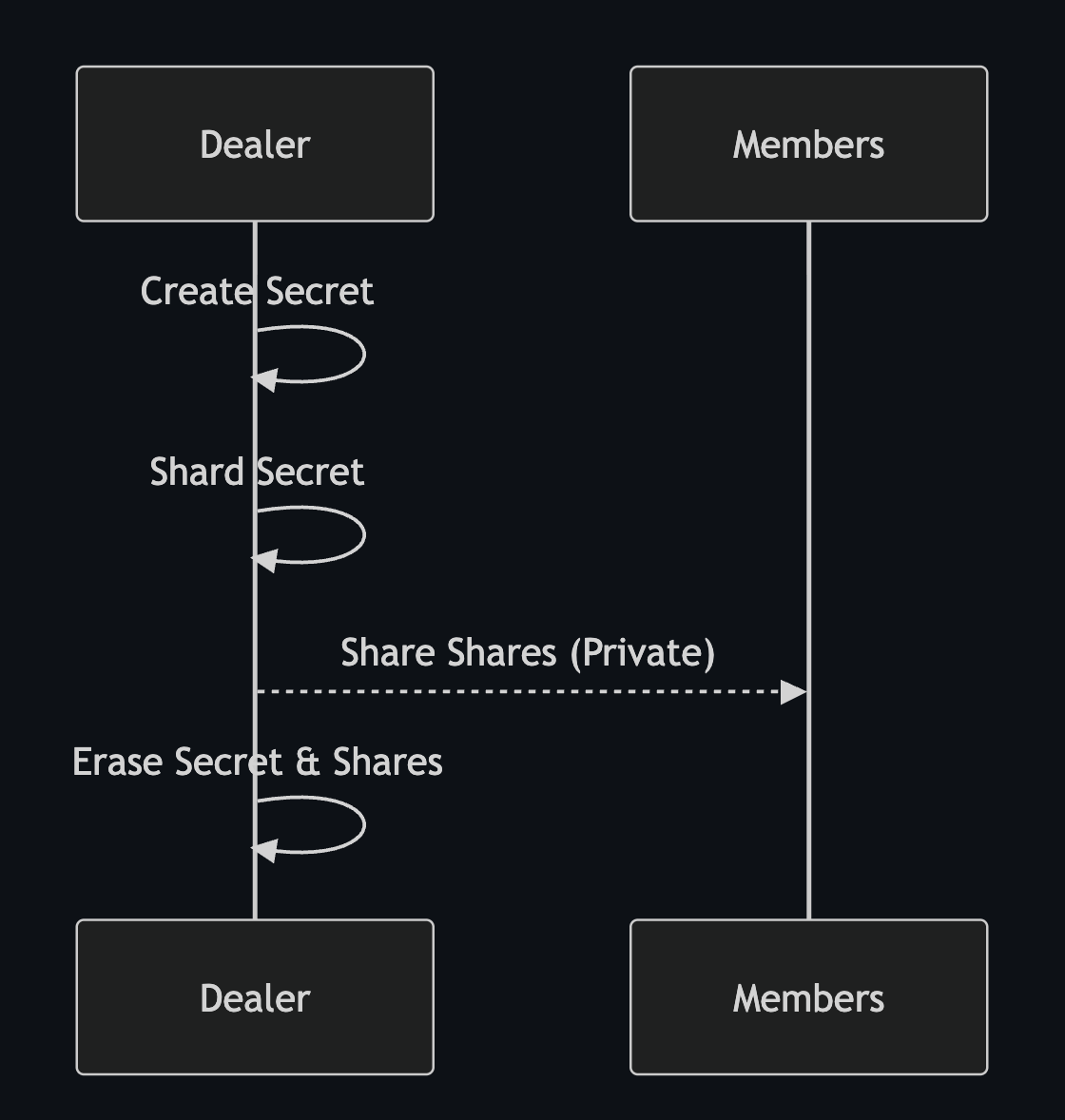
The secret could also be generated in other ways, such as a member creating the secret and handing it to the dealer for distribution.
The Distributed Key Generation (DKG) Process
The FROST paper suggests PedPoP for Distributed Key Generation (DKG) in FROST: Pedersen DKG with Proofs of Possession, which is Torben Pedersen's DKG system as modified by Rosario Gennaro and others to support Verifiable Secret Sharing (VSS). But since, more variants have been offered, such as ChillDKG, which further modifies PedPoP into SimplPedPop, simplifying PedPoP and also making it more securely usable with Bitcoin Taproot.
:warning: WARNING: The lesson here is that DKG is not fully defined for use with FROST. There are a number of different DKG methodologies that could be used. They're all legitimate as long as they generate a set of key shares in a distributed manner that is secure for your security assumptions.
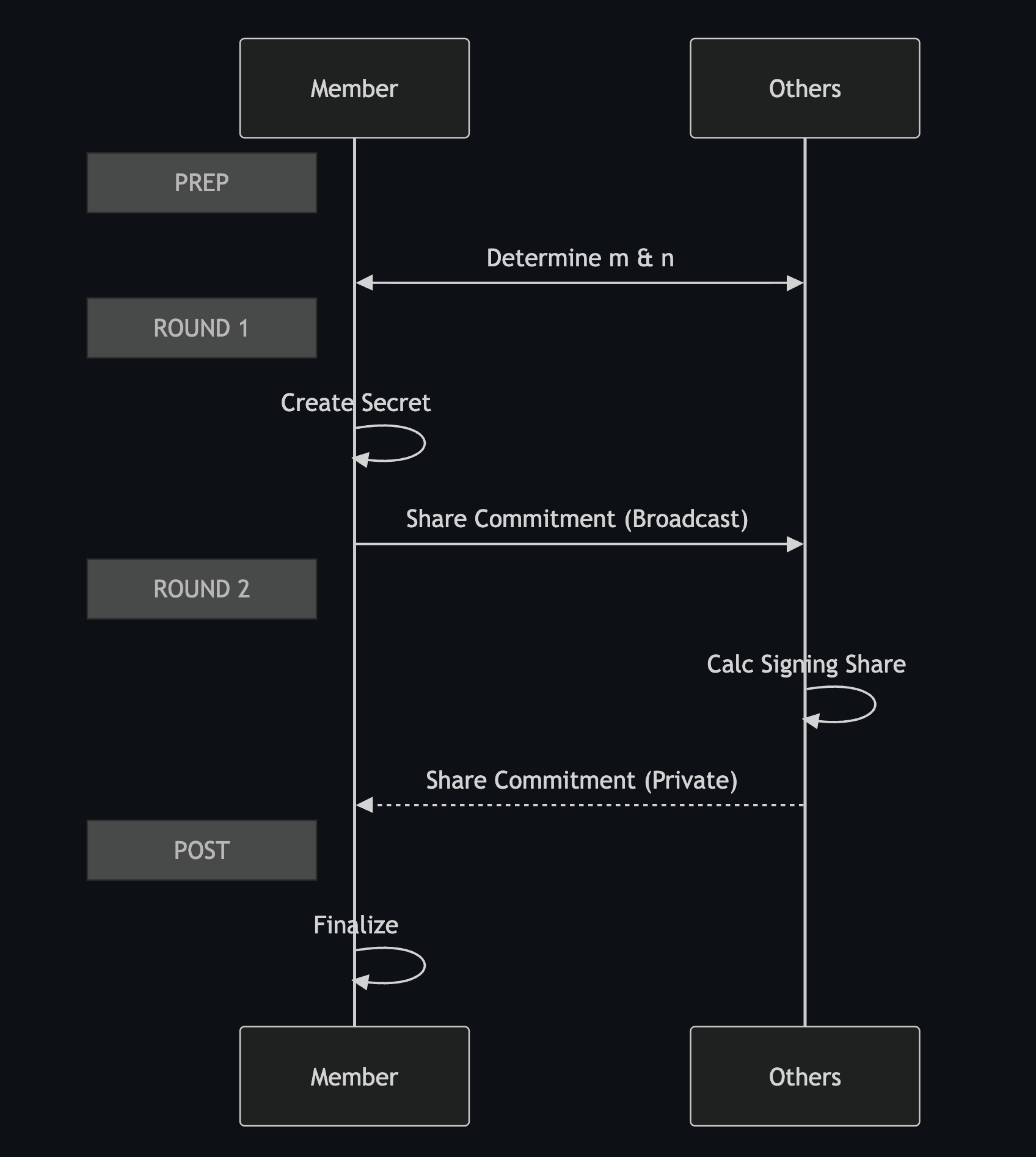
The specifics likely don't manner to you if you're using a library or CLI that has already determined how to generate its shares using DKG. However, here's the general process utilized by the ZF FROST package that's used in this tutorial. It's laid out as "inputs" to the ZF FROST software, "outputs" from the ZF FROST software, and "transmits" among members.
Prep:
- Via some means, the participants agree on member count ("n") and threshold ("m") for the signature (an "m of n" threshold signature).
Round 1:
- Each member inputs their identifier, member count ("n") and threshold ("m").
- Each member outputs public data and secret data.
- Secret data includes two polynomials, which contain the member's secret.
- Public data is a commitment to that secret, in the form of a Pedersen-VSS share.
- Each member transmits their public data to all other members via a broadcast.
- At this point, the joint secret has been fixed.
Round 2:
- Each member inputs their secret data from round 1 and the public data from all the other members from round 1, keyed to the identifier for each member.
- Each member outputs a second set of secret data.
- Secret data now includes the member's share of the joint secret: their private key share.
- Each member outputs response data for each other member.
- Response data includes a commitment using Feldmann-VSS.
- Each members transmits the response data to each other member via an authenticated and encrypted personal communication channel.
Post:
- Each members inputs their second set of secret data, the public data from all other members received at the start of Round 2, and the response packages received back from all members at the end of Round 2.
- Each member outputs their share of the private key and the full group verifying key.
The Signing Process
Signing with FROST is a two-round process, but the first round can be pre-processed to lower overhead at signing time.
The Two-Round Process
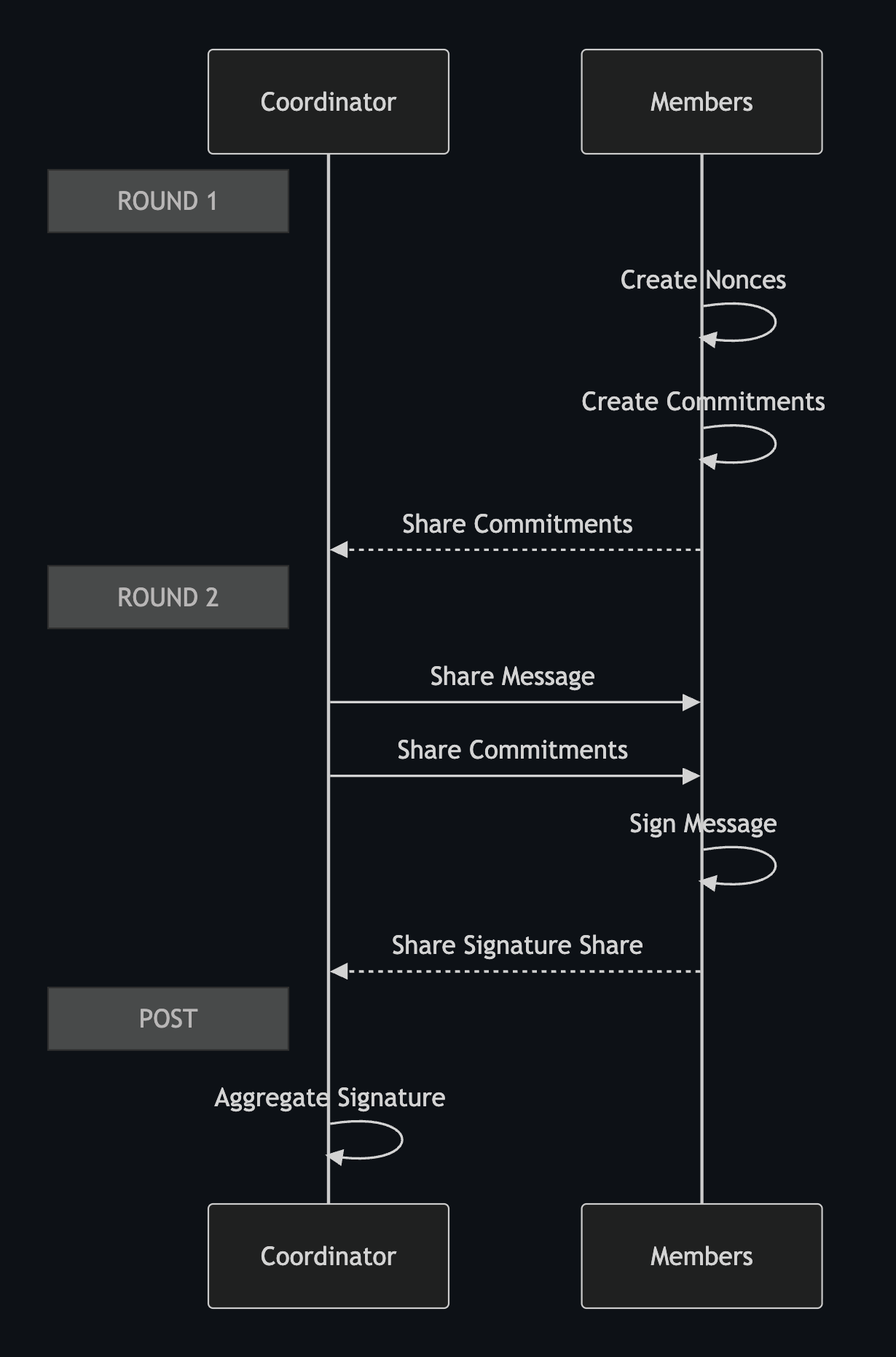
The two-round FROST signature process is best described in §5 of RFC 9591. Round 1 is commitment and round two is signing. A signing coordinator is involved in the process by default: they don't have any special authority or knowledge, but they do take care of the logistics, and as a result could censor the process if they wanted.
Round 1:
- Each member creates two nonces and commitments to those nonces.
- Each member transmits the commitments to the coordinator.
Round 2:
- Coordinator transmits message to chosen members to sign.
- Coordinator transmits relevant commitments to chosen members.
- Each member checks this information.
- Each member uses their secret key share and nonce to sign.
- Each member transmits the resultant signature share to coordinator.
- Each member deletes the nonce used and corresponding commitment.
Post:
- Coordinator checks signature shares.
- Coordinator aggregates signature shares to produce signature.
The Pre-Processed Process
FROST signatures can occur in a single round if the nonces and signatures are preprocessed:
Preprocessing:
- Each member generates a list of several nonces and commitments.
- Each member publishes their commitments in some way.
Round 1:
- Coordinator selects next commitments from list for chosen members.
- Coordinator transmits message to chosen members to sign.
- Coordinator transmits relevant commitments to chosen members.
- Each member checks this information.
- Each member uses their secret key share and nonce to sign.
- Each member transmits the resultant signature share to coordinator.
- Each member deletes the nonce used and corresponding commitment.
Post:
- Coordinator checks signature shares.
- Coordinator aggregates signature shares to produce signature.
Algorithmically, there is no difference between the two-round and pre-processing variants of FROST signatures. It's simply a question of whether the nonces and commitments are generated and stored in advance (pre-processing) or generated on the fly (two-round).
Summary: The FROST Signature Process
There are two ways to create FROST private key shares: through a standard use of Shamir's Secret Sharing or through a more complex Distributed Key Generation sequence that may vary from one FROST library to another.
There are two ways to sign with FROST: through a two-round process or through an equivalent process where the first-round has been pre-processed and stored.
You likely don't need to know the specifics of how each works, but you should understand the two main variations for key generation and signing, so that you can recognize the options offered to your by various libraries.
What's Next
Continue your "Introduction to FROST" by learning more about the underlaying Schnorr signing system and the biggest competitor to FROST in §1.3: FROST vs MuSig2.
Or, if you've seen enough about the nuts and bolts, jump straight to Chapter Two: Signing with FROST for the hands-on tutorial.